Lithium Iron Phosphate vs. Lead-Acid Batteries for Electric Forklifts
Compare lithium iron phosphate and lead-acid batteries for electric forklifts, with practical selection points and a purchasing checklist.
Battery selection affects how an electric forklift fits into your daily operation. For importers and purchasing managers, the right comparison is not limited to battery chemistry. It should also cover duty cycle, charging arrangements, maintenance capability, shift planning, and the forklift configuration required for the application.
Lithium Iron Phosphate vs. Lead-Acid: The Main Differences
Lithium iron phosphate batteries are often considered for operations that need convenient charging and reduced routine battery work. Lead-acid batteries remain a practical option where the operating schedule, charging area, and maintenance process are already organized around conventional battery care.
Battery life should be evaluated as a usage pattern rather than as a single headline figure. The industry reference gives lead-acid batteries an average cycle life of about 1,000–1,500 cycles and lithium-ion batteries about 3,000 cycles, while actual service life varies with maintenance conditions.
Maintenance is another important dividing line. Lead-acid batteries require equalization charging, temperature control, and electrolyte-level management. Lithium-ion batteries can balance automatically and do not require electrolyte-level management.
Charging and Multi-Shift Operation
Charging practice can influence equipment availability. Lithium batteries can be opportunity-charged during a 15-to-30-minute break, typically require 1–2 hours for a full charge, and do not need the cooling period associated with lead-acid batteries.
Before choosing the battery type, map the working day. Record operating hours, break periods, shift changes, available charging locations, and whether a forklift can be removed from service for charging. A battery that matches the actual schedule is generally more useful than one selected only from a technology preference.
For multi-shift operations, ask whether opportunity charging is acceptable in your facility and whether the charger, electrical supply, and site procedures support the selected battery. For lighter or more predictable work, a conventional charging plan may be easier to manage.
How to Select the Forklift Configuration
Start with the load, lift, aisle, and attachment requirements. Rated capacity must match the intended load, while lift height and mast configuration must match the racking and clearance conditions. Fork length and width should be checked against pallet openings and load dimensions.
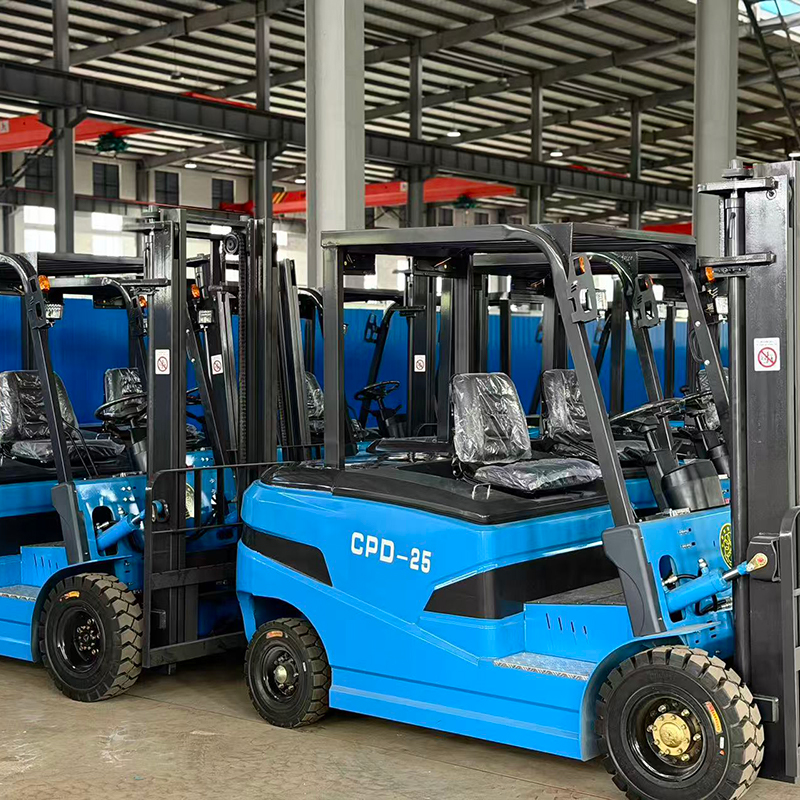
For example, the CPD-25 2.5-ton electric counterbalance forklift has a rated capacity of 2,500 kg, a lift height of 3,000 mm, a fork length of 1,070 mm, a fork width of 100 mm, and a minimum turning radius of 2,400 mm.
The CPD-25 offers battery capacity options of 150, 180, 300, and 400 Ah, together with charger current options of 15, 20, 35, 45, 100, and 200 A. These options should be checked against the selected battery system, working schedule, and local electrical conditions before final configuration.
If your load requirement is different, the CPD-15 and CPD-20 models have rated capacities of 1,500 kg and 2,000 kg respectively. Their minimum turning radii are 1,920 mm and 2,100 mm respectively, which can be relevant when comparing operating space requirements.
Purchasing Checklist
- Work pattern: Confirm operating hours, shift structure, break periods, and the required availability of each forklift.
- Battery plan: Decide whether opportunity charging is suitable and confirm the required charging location and process.
- Maintenance resources: Check whether your team can manage equalization charging, temperature control, and electrolyte-level work for lead-acid batteries.
- Vehicle configuration: Verify rated capacity, lift height, fork dimensions, turning radius, mast options, battery capacity, and charger current.
- Site conditions: Review aisle dimensions, floor conditions, loading points, storage layout, and electrical service before approving the specification.
- Documentation: Request the final configuration sheet so the battery, charger, forklift model, and operating requirements are aligned.
Common Selection Mistakes
One common mistake is choosing a battery only by nominal capacity without checking the daily duty cycle. Another is comparing chemistry while ignoring charger compatibility and the available charging routine. It is also risky to select a forklift by rated capacity alone without checking lift height, fork dimensions, turning radius, and aisle conditions.
A further mistake is treating stated cycle life as a guaranteed service result. Actual life depends on maintenance and operating conditions, so your evaluation should include the work environment and management process.
For your next electric forklift project, submit your requirements through the inquiry form on our website. Our engineers will check the configuration according to your operating scenario, including the intended load, working schedule, lifting requirements, and battery-charging plan.